
1. ABSTRACT OR CONCRETE LEGAL NORM
1.1. General
In order to determine whether a legal provision is abstract or specific, the Subject matter of the regulation (=the facts of the case) are decisive (whereas, in the case of general or specific legal provisions, it is the group of persons to whom the provision is addressed).
1.2. Abstract legal norm
One abstract A legal provision applies to a wide range of circumstances without referring to any specific set of facts.
Examples of abstract legal norms: Acts; Regulations; general directives
1.3. Specific legal provision
One specific A legal rule applies to a specific – that is, concrete – set of facts.
Examples of specific legal provisions: Decisions; the exercise of direct administrative authority and coercive power (e.g. a robber caught in the act is arrested and his weapon is seized); individual instructions
1.4. Examples of demarcation
The following examples may help to clarify when a legal provision is abstract and when it is concrete:
a. Examples for abstract legal norms: „Driving a motor vehicle and towing a trailer is … only permitted with a valid driving licence issued by the authorities for the class (§ 2) to which the motor vehicle belongs“ (Section 1(3) of the Driving Licence Act [BGBl I 120/1997, as amended by BGBl I 90/2023]). Section 2(1)(1) to (5) of the Driving Licence Act sets out the „classes of motor vehicles“ for which a driving licence may be issued:
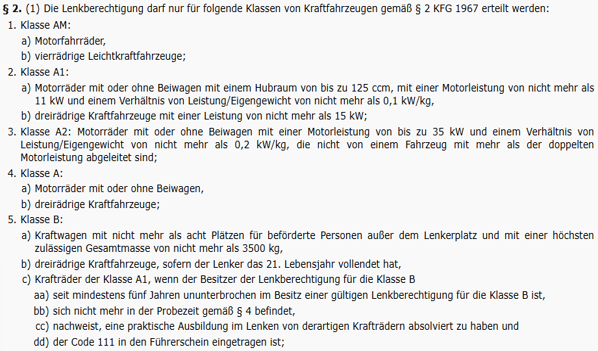
Under Section 1(3) of the Driving Licence Act, driving a motor vehicle is only permitted if the driver holds a driving licence. The vehicles for which such a licence is required are listed in Section 2 of the Driving Licence Act. These include, amongst others, mopeds, motorcycles, motor vehicles (with no more than eight seats for passengers, excluding the driver’s seat, and a maximum mass not exceeding 3,500 kg – this refers to conventional passenger cars) and three-wheeled motor vehicles.
In order to obtain the relevant driving licence, an application must first be submitted; furthermore, depending on the „category of motor vehicle“ sought, the applicant must meet various requirements in accordance with Section 3 of the Driving Licence Act (including being at least 18 or 21 years of age; they must be fit to drive, have completed a first-aid course and passed a driving test).
A wide range of unspecified matters is therefore regulated.
b. Example for a specific legal provision: Daisy the gerbil, residing at 1 Musterstraße, A-1234 Musterstadt, hereby applies, in accordance with Section 5 of the Driving Licence Act, for a driving licence for a passenger car (i.e. Category B). She was born on 1 January 2007 and has therefore reached the age of 18 (Section 6(1)(6) of the Driving Licence Act). It has also been established that she is medically fit (Sections 8 and 9 of the Driving Licence Act) and reliable as a road user (Section 7 of the Driving Licence Act). She has also completed a first-aid course (Section 3(1)(5) of the Driving Licence Act) and passed the relevant driving test (Sections 10 and 11 of the Driving Licence Act). As she has fulfilled all the statutory requirements (= elements of the offence), she is granted a Class B driving licence in accordance with Section 13 of the Driving Licence Act.
1.5. General or specific / abstract or concrete
As a general rule, laws and regulations general-abstract. Generally speaking, because they apply to a group of addressees defined by generic characteristics (e.g. vehicle owners) and abstract, because they apply to a wide range of situations (e.g. driving cars, motorbikes or three-wheeled motor vehicles).
Decisions and judgements, on the other hand, are generally individual and specific. Personalised, because Daisy the gerbil has been granted a driving licence, and Specifically, because she is authorised to drive a Class B motor vehicle – and therefore a car.
2. TO PUT IT IN A NUTSHELL
Whether a legal provision is abstract or specific depends on the circumstances it governs: an abstract provision applies to many possible, unspecified circumstances, whilst a specific provision applies only to one particular set of circumstances.
In general or in abstract terms: We’d be happy to look into your case. Score points with us!
Written by:

SHMP Schwartz Huber-Medek Partner Rechtsanwälte GmbH
Hohenstaufengasse 7
A-1010 Vienna
tel: +43.1.513 50 050
fax: +43.1.513 50 05-50
office@shmp.at