1. GENERAL
Article 1 of the Federal Constitutional Law (B-VG) states: „Austria is a democratic republic. Its sovereignty derives from the people“.
The word ‘democracy’ comes from Greek: dēmos and means „people“ and kratein „to rule“. Democracy therefore literally means „rule by the people“. In a democracy, then, the people themselves are the source of state power. This means that the people determine the law. All state power emanates from the people. Every act of the state – at both federal and state level – must therefore (ultimately) be traceable back to the will of the people.
According to Hans Kelsen The particular value of democracy (and its advantage over other forms of decision-making in government) lies in the acceptance of the law: since everyone can participate in the creation of legal norms, the likelihood that everyone will also abide by these legal norms – which they themselves have created – is relatively greatest.
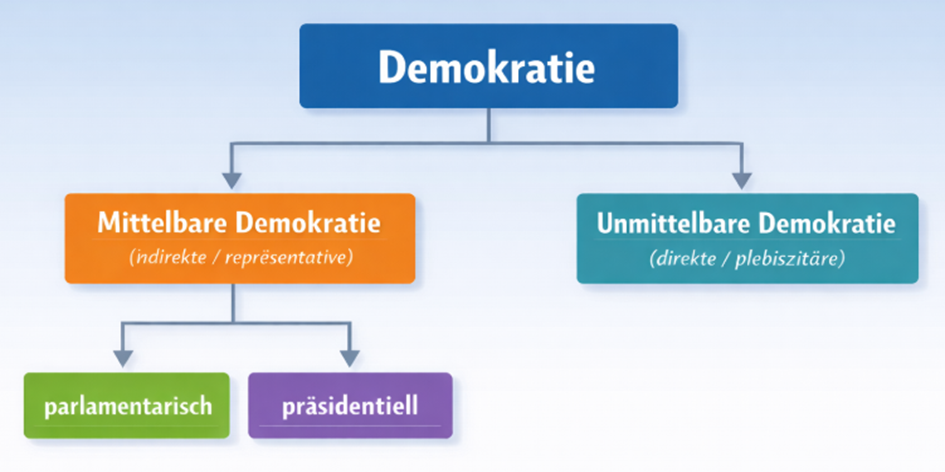
There are different types of democratic government. A distinction is made between representative democracy and direct democracy. In practice, hybrid systems are common, in which, whilst one particular system predominates, elements of the other form of democracy are also present. For example, Austria is generally regarded as a parliamentary democracy, but it also has instruments of direct democracy such as referendums, citizens’ initiatives and public consultations, although these are less prominent than in, for example, the Swiss Confederation.
The indirect Democracy is also known as „indirect“ or „representative“ democracy. In this system, the people elect representatives who act on their behalf within the state and pass laws. These elected representatives are known as members of parliament; they represent the people in parliament and are, in principle, responsible for passing laws on behalf of the population.
Indirect democracy can take two forms: parliamentary democracy – as seen, for example, in Austria, Germany, Italy, the Czech Republic and Slovenia – or presidential democracy, as practised, for instance, in the USA and France. The decisive factor in determining which category a system falls into is which institution (parliament or the president) holds the greater political influence.
In the parliamentary In a parliamentary system, the government is elected by parliament, whereas in a presidential system it is appointed by the president. Accordingly, responsibilities are also distributed differently: in a parliamentary democracy, the government bears both political and legal responsibility to parliament. Parliament may withdraw its confidence in the government and thus dismiss it. In the presidential In this system, however, political and legal responsibility for the government lies with the President; it is also the President’s prerogative to appoint and dismiss the government that has (or loses) his confidence.
The immediate Democracy is also known as „direct“ or „plebiscitary“ democracy. The people themselves create the law directly, usually through referendums (plebiscites).
The country with the strongest tradition of direct democracy is Switzerland. (Admittedly, this does not mean that the population gathers under a tree or in a square to pass laws themselves, but rather that laws are enacted through a hybrid form of direct and representative democracy).
Finally, a distinction is also made between neutral and defensive democracy. This topic is also covered in a separate ‘Knowledge Bite’.
In Austria, the fundamental principle of democracy is set out in Article 1 of the Federal Constitutional Law (B-VG). It is stated there as a fundamental principle, without specifying in detail how democracy is to be organised; this detailed organisation is set out in those constitutional provisions which specifically regulate the people’s participation in the formation of state policy or which can be traced back to the will of the people.
2. THE OPPOSITE OF DEMOCRACY
The opposite of democracy is autocracy („self-rule“). Whilst in a democracy the people are involved in the making of laws, in an autocracy they are excluded from the legislative process. The legal system is determined either by a single person – an autocrat – or by a small group of rulers, known as an oligarchy. Absolute monarchies are also autocratic in this sense.
3. TO PUT IT INTO A NUTSHELL
Not all democracies are the same – they can be organised in different ways. A basic distinction is made between direct (or plebiscitary) democracy and indirect (or representative) democracy. Direct democracy refers to a system in which the people are directly involved in the process of law-making. This means that citizens themselves vote on laws or political issues, for example in referendums.
In representative democracy, the people do not participate directly in the making of laws. To this end, citizens elect representatives who pass laws and make political decisions in parliament. Within this form of government, a distinction is made between parliamentary democracy, in which the government is elected by parliament, and presidential democracy, in which the government is appointed by the president.
In practice, most countries have hybrid forms of these democratic systems. We will look in more detail at how democracy works in Austria next week.
Would you like to make use of a direct democratic instrument and, for example, launch a citizens’ initiative? We’ll support you in doing so. Score points with us!
Written by:

SHMP Schwartz Huber-Medek Partner Rechtsanwälte GmbH
Hohenstaufengasse 7
A-1010 Vienna
tel: +43.1.513 50 050
fax: +43.1.513 50 05-50
office@shmp.at