
1. GENERAL
All government action is based on a legal foundation – namely the constitution and the laws, regulations, administrative decisions, court judgements, etc., derived from it. The rule of law is therefore a constitutional state.
The concept of the rule of law can essentially be traced back to Immanuel Kant. In his work *Metaphysics of Morals*, published in 1797, he already refers to „civil rights“, the „legality of administration“ and the „procedural rights“ of citizens to defend their rights.
It is now generally accepted that a constitutional state is characterised, in particular, by the following features: Firstly, there must be an obligation that all state action may only be taken in accordance with the law (= the law is the basis – and not merely the limit – of state action!); this obligation is set out in Article 18(1) of the Federal Constitutional Law (B-VG). Secondly, a state governed by the rule of law is characterised by the fact that, should a state authority fail to comply with this obligation, there is the possibility of seeking legal redress (= the state governed by the rule of law as a state providing legal protection!). Austria is such a state governed by the rule of law[1].

[1] Even if the imagery in the two illustrations below is manipulative: whether a state is conceived as a „constitutional state“ or a „police state“ says nothing about whether its citizens are thriving. Where a law is devoid of substance or merely sanctions „immoral/bad“ behaviour, those subject to the law may well be worse off than in, for example, an enlightened absolutist police state. However, the existence of structures based on the rule of law generally leads to greater individual freedom, which in turn generally leads to that ideal of „Western democracies“ which we strive to realise.
The opposite of the rule of law is the police state. In a police state, state authority is not bound by laws and can therefore act largely unchecked and without restriction. State action is thus not subject to any legal scrutiny. This creates the possibility that authorities may – with impunity – arbitrarily infringe upon citizens’ rights.
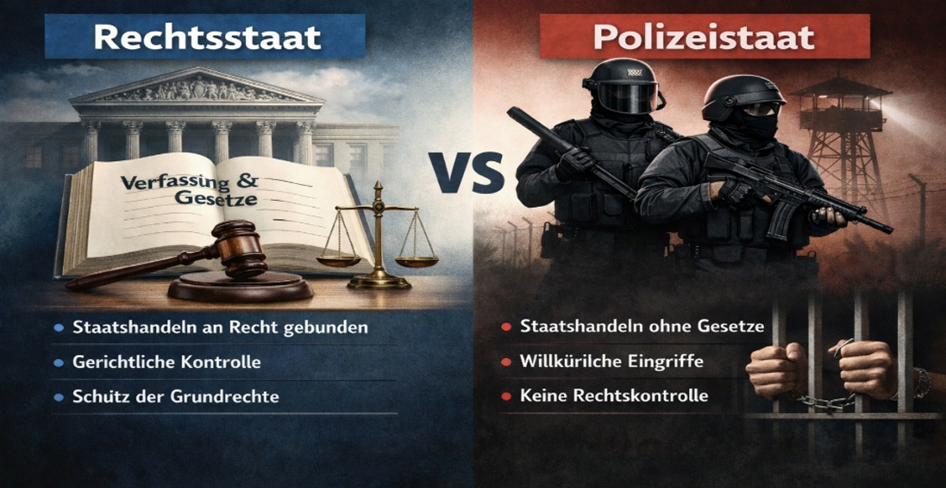
The following (ideal-typical) examples illustrate what this difference actually means:
a. Arrest: If, for example, a person is arrested by the police, this is only permissible in a state governed by the rule of law – such as Austria – under clearly defined legal conditions. Under Section 170 of the Code of Criminal Procedure (StPO), an arrest may only be made if there is concrete suspicion of an offence and a lawful ground for detention (for example, if a person has been caught in the act and there is a risk of them absconding). Furthermore, the arrested person is entitled to certain rights. These include, in particular, the right to a defence, the right to have their detention reviewed by an independent court within the time limits laid down by law, and the right to be released from custody if the legal conditions for continued detention are no longer met.
In a police state, on the other hand, such legal safeguards do not exist. Arrests can be made there even without any concrete suspicion of a crime and are therefore arbitrary (for example, if a person expresses their opinion and thereby displeases the head of state). Review by an independent court either does not take place at all or only at a time determined at the state’s discretion. Nor is the release of the person concerned based on legal criteria, but solely at the discretion of the state authorities – and may not take place at all.
b. House building: In Austria, as a state governed by the rule of law, a person has a subjective public right to be granted planning permission (subject to any conditions, where applicable) provided that the statutory requirements are met. If the application for a planning permission is rejected, it is possible to lodge an appeal against the decision and have it reviewed by a court.
In a police state, on the other hand, the decision on whether to grant such authorisation does not depend on clear legal provisions, but is left to the „unfettered“ discretion of the authorities. Permission may therefore be granted – or it may not. If it is refused, there is no possibility of appealing against the decision or having it independently reviewed, as there is no legal basis to which the acting body would be bound. State action is thus arbitrary, but is not considered unlawful because there are no legal standards or control mechanisms in place.
Nor is the fundamental principle of the rule of law expressly enshrined in the Federal Constitutional Law (B-VG). It is only when considered as a whole that the constitutional provisions demonstrate that Austria is a state governed by the rule of law. In the second part on the fundamental principle of the rule of law, these constitutional provisions are examined in greater detail.
2. EXAMPLES OF THE RULE OF LAW / POLICE STATE
All Member States of the European Union – that is, in addition to Austria, Germany, France, Italy, the Netherlands, Slovenia, the Czech Republic, Hungary, etc. – are states governed by the rule of law (and are mutually protected by the „rule of law mechanism“ under Article 7 of the TEU). In addition, of course, this also includes Norway, Switzerland, Iceland, Liechtenstein, Canada, the USA, Japan, etc.
North Korea, for example, is considered a police state. Examples from the past include the Nazi state, the Soviet Union and the GDR.
3. TO PUT IT INTO A NUTSHELL
Austria is a state governed by the rule of law. This means that all state action must be based on the law and can be reviewed by independent judges. The opposite of this is a police state, in which state power is not subject to any legal constraints. Citizens do not enjoy enforceable rights; they cannot have state actions independently reviewed.
No matter which government action has had a negative impact on you: we’ll fight for your rights! Join us and make a difference!
Written by:

SHMP Schwartz Huber-Medek Partner Rechtsanwälte GmbH
Hohenstaufengasse 7
A-1010 Vienna
tel: +43.1.513 50 050
fax: +43.1.513 50 05-50
office@shmp.at