1. GENERAL
For a change, today’s post begins with a quotation, namely a quotation from Konrad Adenauer, who served as the first Federal Chancellor of the Federal Republic of Germany from 1949 to 1963. To this day, the quote is frequently cited in connection with his understanding of democracy and, on occasion, also linked to the political reactions to the popular uprising of 17 June 1953[1]. However, the exact historical origin or the direct context of the quote cannot be conclusively established.
[1] On 17 June 1953, the first major popular uprising against the communist system of the Socialist Unity Party of Germany (SED) took place in the GDR. The uprising was triggered by poor living conditions, political oppression and an increase in work quotas (i.e. work output) without a corresponding rise in wages. A nationwide strike developed, involving around one million people. The people demanded better living conditions, free elections and greater freedom. The uprising was ultimately crushed by force, primarily by the Soviet military; more than 50 people lost their lives and thousands were arrested. See also the scathing commentary by Bertold Brecht: „The people have forfeited the government’s trust. Wouldn’t it be simpler, then, for the government to dissolve the people and elect another?“
„Every party is there for the people …“. But what is meant by „party“? In the Austrian political system, the terms political party, political party standing for election and Club used. Although they are often treated as synonymous in everyday language, they have different legal meanings. A clear distinction between the terms makes it easier to understand political structures.
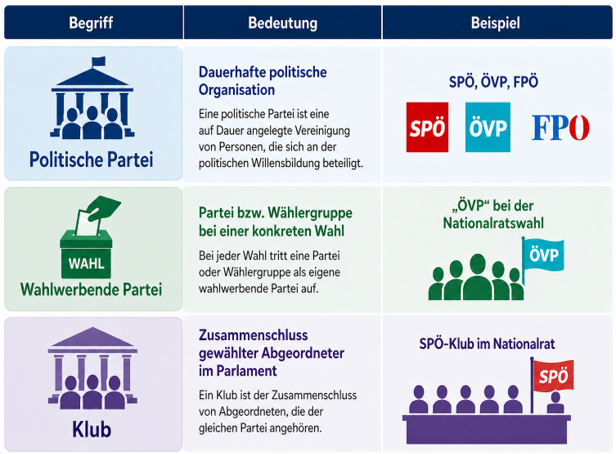
2. THE POLITICAL PARTY: THE PERMANENT ORGANISATION
„The existence and diversity of political parties are essential components of the democratic order of the Republic of Austria“ (Section 1 of the Political Parties Act). The fact that this is enshrined as a constitutional provision – and thus as a fundamental right to freedom of association – underlines the central importance of political parties.
A „political party“ is a long-term organisation which pursues political objectives and seeks to influence the formation of public policy – in particular through elections. The legal basis for this is the Political Parties Act (BGBl I 56/2012, as amended by BGBl I 43/2025; „PartG“).
The Act defines a political party as a „permanently organised association“ (Section 1(2) of the Political Parties Act), the constitution of which is filed with the Federal Minister of the Interior. It is only upon such filing that the party acquires legal personality (Section 1(4), first and second sentences, of the Political Parties Act).
Political parties exist independently of elections. In particular, they draw up (party) manifestos, organise their members and carry out public relations work (communicating with the public, presenting political positions in the media, etc.).
Examples:
- Social Democratic Party of Austria (SPÖ)
- Austrian People’s Party (ÖVP)
- The Greens – The Green Alternative
- Freedom Party of Austria (FPÖ)
The following examples illustrate that the political landscape can change suddenly, and that the diversity of political parties – as enshrined in the constitutional provision of Section 1 of the Political Parties Act (PartG) – is in fact put into practice: (i) In September 2012, the political party „Team Stronach for Austria“ was founded, and (ii) immediately afterwards, in October 2012, the political party „NEOS – The New Austria and Liberal Forum“ was founded.
3. THE PARTY CAMPAIGNING IN AN ELECTION: THE PARTY DURING AN ELECTION
A distinction must be made between a political party and an „electoral party“ (also known as an „election party“ or „list“), which is defined in Section 2(2) of the Political Parties Act (PartG). According to this, it is „a group of voters which, under a distinctive party name and by fielding a party list, takes part in the election campaign for a general representative body or the European Parliament“. As a rule, these are political parties that stand in a specific election (e.g. National Council election, state parliament election, local council election) with a specific list of candidates.
A party campaigning in an election thus operates within the context of a specific election and is therefore tied to a particular event and timeframe. This also results in limited legal capacity, for example in connection with election challenges.
In practice, a political party and a party standing for election are often one and the same; from a legal perspective, however, they must be clearly distinguished from one another. This distinction is by no means merely theoretical, but takes on considerable practical significance, particularly in the context of election campaign funding, transparency regulations and election campaigning.
Example: NEOS – Das Neue Österreich and Liberales Forum are established as permanent political parties. In the 2024 National Council election, they stood as contesting parties at federal level with the following list of candidates (only the first five are listed here):
- Beate Meinl-Reisinger
- Stephanie Krisper
- Sepp Schellhorn
- Yannick Shetty
- Sophie Wotschke
A regional list was also drawn up for each federal state. For Tyrol, for example, the following candidates were nominated (only the first three are listed):
- Dominik Oberhofer
- Laura Flür
- Eva-Maria Peer
Finally, a regional party list is also drawn up for the respective regional constituencies. Both lists (the state list and the regional party list) together form the state electoral proposal.
The distinction between federal and provincial lists stems from the fact that the National Council election in Austria is conducted in three stages. First, seats are allocated in the regional constituencies. Unallocated seats and remaining votes are then taken into account at the level of the provincial constituencies via the provincial lists. Finally, in a third stage, a nationwide adjustment is made via the federal list. This is intended to ensure that the final election result does not merely reflect regional outcomes, but corresponds as closely as possible to the proportion of votes received by the parties across Austria as a whole.
4. THE CLUB – THE ORGANISATION IN PARLIAMENT
A parliamentary group is neither an electoral alliance nor a political party, but rather an association of members of parliament who have already been elected (at federal or state level – hence there are parliamentary groups at federal level and state parliamentary groups).
For example, following an election to the National Council, Members of Parliament from the same political party may form a (parliamentary) group. In the Austrian National Council, a group must consist of at least five Members of Parliament.
Within the parliamentary group, political and policy issues are discussed and the party’s collective position on debates, motions and votes is determined (de facto party discipline, even though an MP generally holds a free mandate). The group thus coordinates the parliamentary activities of its MPs and forms the organisational hub of a party’s parliamentary work. Each group is chaired by a group leader.
Examples from the National Council: (i) The Green Party parliamentary group, (ii) The Freedom Party parliamentary group.
5. GRAPHICAL REPRESENTATION
6. TO PUT IT IN A NUTSHELL
The three terms „political party“, „party standing for election“ and „club“ are closely related, but must be distinguished precisely: (i) The political party forms the permanent organisational basis for political activity, (ii) the political party standing for election stands for election, and (iii) the Club organises the work of the elected members of parliament.
Do you want to set up a political party and save the world? We’re passionate about it – join us and make a difference!
Written by:

SHMP Schwartz Huber-Medek Partner Rechtsanwälte GmbH
Hohenstaufengasse 7
A-1010 Vienna
tel: +43.1.513 50 050
fax: +43.1.513 50 05-50
office@shmp.at