
1. OBJECTIVE OR SUBJECTIVE LAW
1.1. Objective law
Objective law refers to the legal norms in force in Austria – that is, positive law (or, as it is also known, „statutory“ law, in the sense of „law made by man„). This includes not only legal norms that regulate the relationships between individuals subject to the law (e.g. the General Civil Code (ABGB), the Commercial Code (UGB)), but also legal norms that govern the relationships between the state and those subject to the law (e.g. the Road Traffic Regulations (StVO), the Trade Regulation Act (GewO)). It also encompasses legal norms that establish public authorities or assign tasks to them (e.g. the Federal Constitutional Act (B-VG), the Vienna City Constitution) or that govern the employment relationship of public-sector employees (e.g. civil servants, contract staff). Taken together, all legal norms in Austria constitute “objective law„; they form “the legal system’.
1.2. Subjective right
1.2.1. General
Subjective rights form part of objective law. The term „subjective right“ refers to a legal norm which enables a person subject to the law to enforce their rights by appealing to state bodies (administrative authorities or courts) (e.g. by bringing an action, lodging an appeal or making a complaint). It is essential that a subjective right is also enforceable; this is achieved by making use of the legal remedies provided by the administrative and judicial systems.
1.2.2. Subjective-public or subjective-private law
Subjective rights exist in both private law and public law.
A subjective public right is a right that has its roots in public law (e.g. the Trade Regulation Act – GewO) – and is therefore, as a rule, directed against the state. It gives a person the opportunity to assert their interests vis-à-vis the state (e.g. the right to be granted a trade licence under the Trade Regulation Act). Furthermore, such a right enables a person to ensure compliance with the law in its enforcement (by administrative and judicial authorities) – and thus to ensure that state bodies act lawfully.
A subjective private right is a right rooted in private law (e.g. the ABGB) – and is therefore, as a rule, directed against another private individual. A person subject to the law can thus assert their interests against another person.
1.2.3. A (subjective) right guaranteed by constitutional law
a. General
If a subjective right is enshrined in a constitutional law (and not, as in section 1.2.2, in an ordinary law), it is referred to as a right guaranteed by constitutional law (Article 144(1) of the Federal Constitutional Law) – also known as a fundamental right, a human right or a civil liberty.
These „fundamental rights“ serve to protect the most personal sphere of a person subject to the law from state interference – be it through legislation, the administration or the judiciary – (e.g. the right to life, the right to equality, the right to property, the right to respect for private and family life). Fundamentally, therefore, fundamental rights are rights of defence against the state. They apply, in themselves, only in the relationship between the state and the citizen.
Note: Under Austrian law (unlike in Germany, for example), there is no requirement for codification: fundamental rights may therefore be enshrined in both constitutional laws and ordinary laws. However, the relevant provision must always be adopted with the required quorums (at least 50% members present, at least a two-thirds majority of the members present in the National Council) and, in accordance with Article 44(1) of the Federal Constitutional Law (B-VG), designated as a „constitutional law“ (e.g. B-VG, StGG) or a „constitutional provision“ (e.g. Section 1 of the DSG [BGBl I 165/1999 as amended by BGBl I 50/2025]).
b. Direct effect on third parties
Fundamental rights do not, in themselves, apply between private individuals (as they were originally intended solely in relation to the state). How private individuals structure their legal relationships is, in principle, left to them (private autonomy). They may therefore act in a „discriminatory“ or „arbitrary“ manner when making decisions and are not required to justify these decisions – though, of course, only within the limits laid down by law (e.g. „reduction by more than half“ in accordance with Section 934 of the Austrian Civil Code (ABGB)).
Fundamental rights apply between private individuals only in exceptional cases (= direct third-party effect of fundamental rights). This is the case where it is expressly provided for by law. For example, Section 5(4) of the Data Protection Act 2000 (DSG 2000) provided that the fundamental right to data protection also extended to „legal entities established under private law“. This provision has since been repealed; however, such third-party effect is still presumed on the basis of the constitutional provision in Section 1 of the DSG. Data protection law therefore applies in Austria between the state and natural persons, as well as between individuals (in the latter case, legal persons are also included).
c. The fiscal implications of fundamental rights
But what happens when the state acts like a private individual? In this case, do fundamental rights also apply in the relationship between the state (the tax authorities) and a private individual (e.g. a contractual partner)? Whether such „fiscal application of fundamental rights“ applies has long been a matter of dispute. Particularly in connection with the principle of equality, however, both the Supreme Court and the Constitutional Court now affirm that fundamental rights do indeed apply in this fiscal context.
1.3. Examples
1.3.1 Examples of subjective public rights
Whether a person subject to the law is entitled to a subjective right is determined by the relevant substantive law. Ideally, this is expressly laid down as such (though this is often not the case).
a. Neighbouring rights: Section 134a of the „Vienna Urban Development, Town Planning and Building Code (Building Regulations for Vienna)“ (LGBl 11/1930, as amended by LGBl 45/2025; „Wr BauO“), these subjective rights are defined as follows:
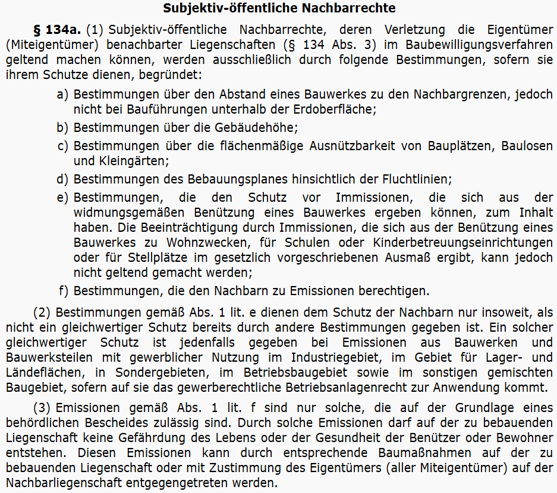
Section 134a of the Building Regulations grants certain neighbours„ rights, which can generally be asserted by means of “objections„ during a planning permission procedure. So, for example, if a neighbour believes that the property boundaries are not being respected, or if they are exposed to nuisances (e.g. excessive noise or insufficient light) caused by the completed “building’ in question, they may raise these objections during the planning permission procedure.
b. Right of access to files: The right of access to files is also an example of a subjective right (arising from the relevant substantive legal provision) – although it is not explicitly designated as such. See Section 17 of the AVG:
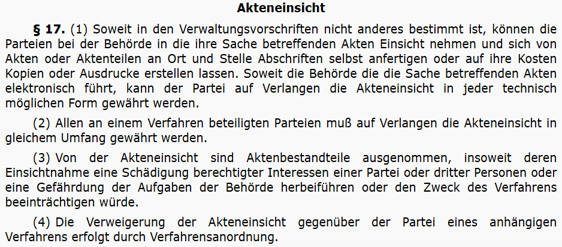
Under Section 17 of the Administrative Procedure Act (AVG), every party (to the proceedings in question) has the right to inspect the case file – they may therefore inspect the file relating to their case at the relevant authority’s offices.
In practice, it can sometimes be difficult to determine whether a person is granted a subjective right. There is a „rule of thumb“ here: whose interests is the provision intended to protect? That person is the party concerned.
1.3.2. Examples of subjective and private rights
Unlike in public law, where, alongside subjective public rights, there are many rights that are „merely“ objective public rights (and which, as such, the administrative authorities are only required to exercise ex officio), the ABGB, for example, consists practically entirely of subjective private rights.
a. Contract of sale: Section 1053 of the ABGB, for example, provides as follows:
„Under a contract of sale, an item is transferred to another person in return for a specific sum of money. Like barter, it is one of the ways of acquiring ownership. Ownership is only acquired upon delivery of the item sold. Until delivery takes place, the seller retains the right of ownership.“.
If a valid contract of sale has been concluded and the seller has handed over the goods, the seller may bring legal proceedings against the buyer to recover the purchase price should the buyer fail to pay it voluntarily.
b. Acquisition of the inheritance: In accordance with Section 536 of the ABGB, the heir acquires „the right to inherit (acquisition of the inheritance) upon the death of the deceased (opening of the succession) or upon the fulfilment of a condition precedent“.
Upon the death of the deceased, the heir is entitled to claim the return of his or her inheritance from the estate; he or she may also assert this legal claim through legal proceedings.
1.3.3. Examples of rights guaranteed by the Constitution
Under Article 83(2) of the Federal Constitutional Act (B-VG), „[n]o one may be deprived of their right to a lawful judge“.
Article 7(1) of the Federal Constitutional Law (B-VG) stipulates that „all citizens are equal before the law“. The same is also laid down in the StGG 1867. According to Article 2 thereof, „[a]ll citizens are equal before the law“.
Under Article 5 of the StGG, property is inviolable. „Expropriation against the owner’s will may only take place in the cases and in the manner prescribed by law“.
Article 17 of the StGG stipulates that „science and its teaching … are free“.
2. TO PUT IT IN A NUTSHELL
The term ‘objective law’ refers to the Austrian legal system in its entirety. Subjective law refers to a right of the individual which can be enforced by bringing a claim before state authorities. Whilst every subjective right is thus based on objective law, not every provision of objective law simultaneously confers a subjective right.
We’d be happy to help you exercise your subjective rights, whether they are of a subjective-public or subjective-private nature. Score points with us!
Written by:

SHMP Schwartz Huber-Medek Partner Rechtsanwälte GmbH
Hohenstaufengasse 7
A-1010 Vienna
tel: +43.1.513 50 050
fax: +43.1.513 50 05-50
office@shmp.at