
1. SUBSTANTIVE AND PROCEDURAL LAW
1.1. Substantive law
Substantive law refers to all legal norms that lay down for those subject to the law the requirements, prohibitions, permissions and authorisations (elements of an offence), as well as the associated legal consequences (legal effects).
Substantive law therefore not only specifies the rights and obligations of those subject to the law, but also sets out the powers and duties of state bodies. It determines the substance of enforcement actions („What is the substance of the law?“).
Examples: General Civil Code („ABGB“), Companies Act („UGB“), Trade Regulation Act 1994 („GewO“), Road Traffic Regulations 1960 („StVO“), Motor Vehicles Act 1967 („KFG“).
1.2. Formal law
Formal law includes organisational law (Which state body is responsible for enforcing the law?) and procedural law (How should the competent state body proceed when enforcing the law?). Specifically:
a. Organisational law
To aid understanding, we shall begin by looking at organisational jurisdiction and association jurisdiction, which form part of organisational law:
- Organisational responsibility or association responsibility
Introduction: The state is organised through positive law. This organisation (federation) is an abstract construct which, in Austria (in accordance with Article 2(1) and (2) and Article 116 of the Federal Constitutional Law), consists in particular of the territorial authorities – the Federal Government, the provinces and the municipalities – (though it also includes, for example, professional bodies such as chambers or public-law institutions such as the ORF).
Each level of government (federal, provincial and local) is vested with certain powers, in particular due to the distribution of powers (in accordance with Articles 10 to 15 of the Federal Constitutional Law). In a state organised on the basis of the separation of powers – such as the federal state of Austria – legislation, administration and the judiciary are also organised, depending on the level of government (federal, provincial or local*), through the allocation of specific governmental competences: (i) the legislative organisation of the federal government and the provinces; (ii) the administrative organisation of the federal government, the provinces and the municipalities; and (iii) the judicial organisation of the federal government and the provinces.
Examples: Articles 10 to 15 of the Federal Constitutional Act (B-VG); Articles 116(2), 118(2) and 118(4) of the Federal Constitutional Act (B-VG) (municipalities’ own sphere of competence*).
As an abstract construct, this organisation is not capable of acting on its own, which is why, in order to exercise its respective responsibilities, Organs requirements. Every organisation – that is, every association – therefore consists of a multitude of bodies, each of which in turn has specific (bodily) responsibilities.**
- „Miscellaneous“ Organisational Law
Of course, these (state) bodies must also be established and their powers regulated. Organisational law therefore governs, in particular, the
- Establishment of legislative, administrative and judicial bodies;
- Setting their agendas;
- Definition of the relationships between the institutions (e.g. appeal procedures);
- Determining the composition of the bodies (e.g. number, selection criteria);
- Determining the decision-making process (e.g. unanimity);
- Definition of the territory within which they are authorised to operate (e.g. administrative district).
Examples: The Rules of Procedure Act 1975 (which sets out the Rules of Procedure of the National Council), the Rules of Procedure of the Federal Council, and the Federal Ministries Act 1986 („BMG“).
* In accordance with Article 116(1) of the Federal Constitutional Law (B-VG), each federal state is divided into municipalities; these are therefore part of the state’s territory and occupy a special position (key point: the municipality as a self-governing body).
** In reality, the organs are also an abstract construct – there is always a need for people to carry out the functions of the organs (so-called „organ administrators“).
b. Procedural law
Procedural law governs the manner and form in which the authorised bodies (see point 1.2(a)) are to apply and implement the law (particularly substantive law). It therefore addresses the question: „How should the law be enforced?“
Examples: Code of Civil Procedure („ZPO“), the General Administrative Procedure Act 1991 („AVG“), the Administrative Court Procedure Act („VwGVG“), the Administrative Court Act 1985 („VwGG“), and the Constitutional Court Act 1953 („VfGG“).
2. EXAMPLES
2.1. Substantive law
In accordance with Section 102(3), fifth sentence, of the Road Traffic Act (KFG) (Federal Law Gazette 267/1967, as amended by Federal Law Gazette I 50/2025), the following applies: „Whilst driving, the driver is prohibited from making telephone calls without using a hands-free kit, as well as from any other use of a mobile phone, except as a navigation system, provided that it is securely mounted inside the vehicle.“
If a driver fails to comply with this provision, they are committing an administrative offence under Section 134(3c) of the Road Traffic Act (KFG) and shall be liable to a fine of EUR 100.00 or EUR 140.00, imposed by the competent authority depending on how the offence was detected (stopping the vehicle or camera-based traffic surveillance).
2.2. Formal law
2.2.1. Organisational law
a. Organisational responsibility:
- Article 10(1) of the Federal Constitutional Act (B-VG) provides that the Federal Government has the power to legislate and enforce legislation in relation to, amongst other things, the following matters:
-
- Z 1: „The Federal Constitution, in particular elections to the National Council, and initiatives, referendums and public consultations under the Federal Constitution; constitutional jurisdiction; administrative jurisdiction, with the exception of the organisation of the administrative courts of the federal states“;
- Z 4: „Federal finances, in particular public levies which are to be collected exclusively or in part for the Federal Government; monopolies“;
- Z 5: „Finance, credit, stock exchanges and banking; weights and measures, standards and hallmarks“;
- Z 15: „military affairs; civil service matters; war damage claims; the maintenance of war graves; measures deemed necessary, either on the occasion of a war or in its aftermath, to ensure the uniform management of the economy, in particular with regard to the supply of essential goods to the population“.
- Pursuant to Article 15(1) of the Federal Constitutional Act (B-VG), any matter which „is not expressly assigned by the Federal Constitution to the legislative or executive powers of the Federal Government … remains within the independent sphere of competence of the Länder“.
- In accordance with Article 24 of the Federal Constitutional Act (B-VG), the National Council exercises federal legislative power jointly with the Federal Council.
b. Other organisational law:
- Article 47 of the Federal Constitutional Law (B-VG) stipulates that, for federal laws to come into force in accordance with the Constitution, they must be countersigned by the Federal President.
- In accordance with Section 3(1) of the Rules of Procedure Act 1975, the newly elected National Council shall be convened by the Federal President within 30 days of the election.
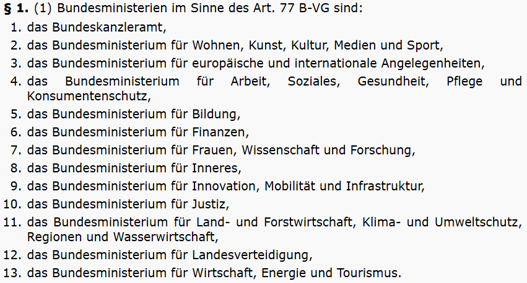
- Section 1 of the Federal Ministries Act (BMG) sets out which federal ministries currently exist in Austria:
2.2.2. Procedural law
Under Section 40 of the AVG, oral hearings are to be „conducted in the presence of all known parties to the proceedings, as well as the necessary witnesses and experts“.
Section 7(4) of the VwGVG stipulates that an appeal may be lodged against decisions of an administrative authority (pursuant to Article 130(1)(1) of the B-VG) within a period of four weeks (usually from the date of service).
2. TO PUT IT IN A NUTSHELL
Substantive law governs the substance of the law. Procedural law, on the other hand, can be divided into organisational law (which state body is responsible for enforcing the law) and procedural law (how should the competent state body proceed when enforcing the law?).
Whether you have questions about substantive or procedural law – we are here to help. If a government body without jurisdiction takes action against you, your fundamental right has been infringed (Article 83(2) of the Federal Constitutional Law: „Right to a lawful judge“)! Let us help you win your case!
Written by:

SHMP Schwartz Huber-Medek Partner Rechtsanwälte GmbH
Hohenstaufengasse 7
A-1010 Vienna
tel: +43.1.513 50 050
fax: +43.1.513 50 05-50
office@shmp.at