
1. GENERAL
„Austria is a “State". This is set out succinctly in Article 2(1) of the Federal Constitutional Law (B-VG). „The Federal State is composed of the following autonomous provinces: Burgenland, Carinthia, Lower Austria, Upper Austria, Salzburg, Styria, Tyrol, Vorarlberg and Vienna“.
In accordance with Article 3(1) of the Federal Constitutional Law (B-VG), the federal territory comprises the territories of the federal states. Each federal state’s territory is therefore also part of the federal territory. Austria thus consists of nine constituent states (the federal states) and the central government (the Federation).
Each constituent state – that is, each federal state – and the federal government possess their own state authority – and thus their own state organisation. In contrast, in a Unitary state only a single, unified state authority, which may be organised either centrally (e.g. in Iceland or Israel) or decentrally (e.g. in France or Sweden). As a federal state, Austria has a decentralised structure, which is why state authority is divided between the federal government and the provinces. The specific powers vested in the federal government and the provinces in the areas of legislation, administration and the judiciary are set out in Articles 10 to 15 of the Federal Constitutional Law (B-VG).
A distinction must be made between a federal state and a unitary state, namely the Confederation (also known as a confederation). Such a confederation consists of a voluntary association of independent and autonomous states. It has no legal personality of its own. The basis for such a confederation is treaties under international law. State authority generally remains with the sovereign states – there is therefore no single central authority for the confederation. The member states delegate only strictly limited tasks to joint bodies, which, however, cannot exercise direct sovereign authority over citizens. Unlike in a federal state, the relations between the member states are governed not by constitutional law but by international law. A historical example of such a confederation was the German Confederation (1815–1866), which consisted of 39 sovereign German states and free cities. The confederation served primarily to ensure the internal and external security of its member states.
According to prevailing legal doctrine, the European Union is not regarded – as one might perhaps assume at first glance – as a confederation of states, but rather as Confederation of States. This is because it has its own legal personality and far-reaching powers (e.g. shared competences in the areas of the environment, energy, etc., and exclusive competences regarding the customs union or monetary policy). It therefore occupies an intermediate position between a confederation and a federal state.
2. CONSEQUENCES
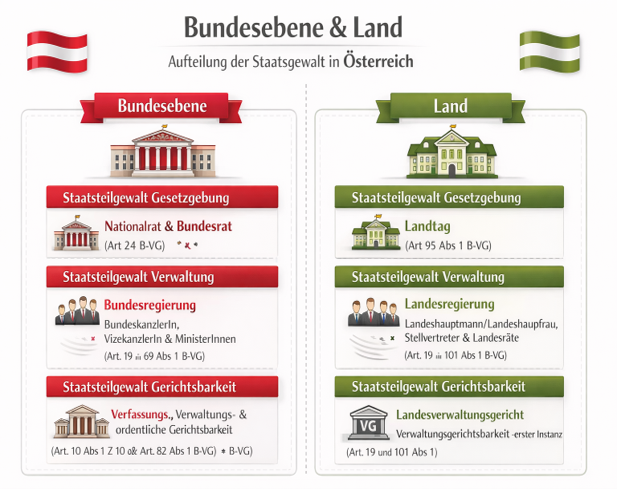
What are the consequences of Austria being a federal state? A key feature of the federal system is the division of state power between the federal government and the provinces. This division of powers means that both the federal and provincial levels have their own distinct responsibilities in the areas of legislation, administration and the judiciary:
a. Federal level
- Legislative power: Federal legislative power is exercised by the National Council in conjunction with the Federal Council (Article 24 of the Federal Constitutional Act).
- Executive Power: The Federal Administration is headed by members of the Federal Government (the Federal Chancellor, the Vice-Chancellor and the other ministers). It is responsible for the highest-level administrative affairs of the Federal Government, insofar as these are not delegated to the Federal President (Articles 19 and 69(1) of the Federal Constitutional Act (B-VG)).
- Judicial branch of government: Federal jurisdiction comprises constitutional jurisdiction and administrative jurisdiction, with the exception of the organisation of the administrative courts of the federal states (Article 10(1)(10) of the Federal Constitutional Law (B-VG)); ordinary jurisdiction (i.e. civil and criminal courts; Article 82(1) of the Federal Constitutional Act (B-VG)).
b. Country
- Legislative power: Legislative power in the province is exercised by the Provincial Parliament (Article 95(1) of the Federal Constitutional Law).
- Administrative branch of government: The provincial administration is headed by the members of the provincial government (the provincial governor, his or her deputy, and the other provincial councillors). It is responsible for the highest-level administrative affairs of the province (Articles 19 and 101(1) of the Federal Constitutional Act).
- The judicial branch of government: State jurisdiction is derived from state administrative jurisdiction (e.g. administrative courts of first instance).
Note: Despite the two levels of government (federal and provincial), there is, of course, a single citizenship for the Republic of Austria. There is therefore no separate citizenship for the individual federal provinces (Article 6(1) of the Federal Constitutional Law). However: Citizens who are resident in a particular federal state are also citizens of that state (Article 6(2) of the Federal Constitutional Law).
3. Graphic
4. TO PUT IT INTO A NUTSHELL
Austria is a federal state comprising nine federal states – Burgenland, Carinthia, Lower Austria, Upper Austria, Salzburg, Styria, Tyrol, Vorarlberg and Vienna.
As a federal state, Austria has a decentralised structure, which is why state authority is divided between the federal government and the provinces. Consequently, both the federal and provincial levels have their own respective powers in the areas of legislation, administration and the judiciary (distribution of powers in accordance with Articles 10 to 15 of the Federal Constitutional Law).
Whether you’re affected by a state or federal law – we’ll fight alongside you to defend your rights at both state and federal level. Score a win with us!
Written by:

SHMP Schwartz Huber-Medek Partner Rechtsanwälte GmbH
Hohenstaufengasse 7
A-1010 Vienna
tel: +43.1.513 50 050
fax: +43.1.513 50 05-50
office@shmp.at