1. A BRIEF HISTORY OF THE (FIRST) REPUBLIC
Under Article 1 of the Federal Constitutional Law (B-VG), Austria is a „democratic republic“. However, it was not so long ago that the form of government was fundamentally different: until the end of the First World War (1914–1918), the Austro-Hungarian Monarchy, organised as a monarchist multi-ethnic state, existed on what is now Austrian territory.
The transition from a monarchy to a republic was a direct consequence of the long and gruelling First World War; the monarch lost both prestige and power, whilst the population was scarred by the years of deprivation during the war and suffered from a severe famine. Unrest and revolutionary sentiment were on the rise amongst the population.
Against this background, Emperor Charles I of Austria (as Charles IV, King of Hungary) renounced „any involvement in the affairs of state“ on 11 November 1918 (see the following statement; available at https://upload.wikimedia.org/wikipedia/commons/6/61/Verzichtserklärung_Karl_I._11.11.1918.jpg; a copy is on display at the Museum of Military History).
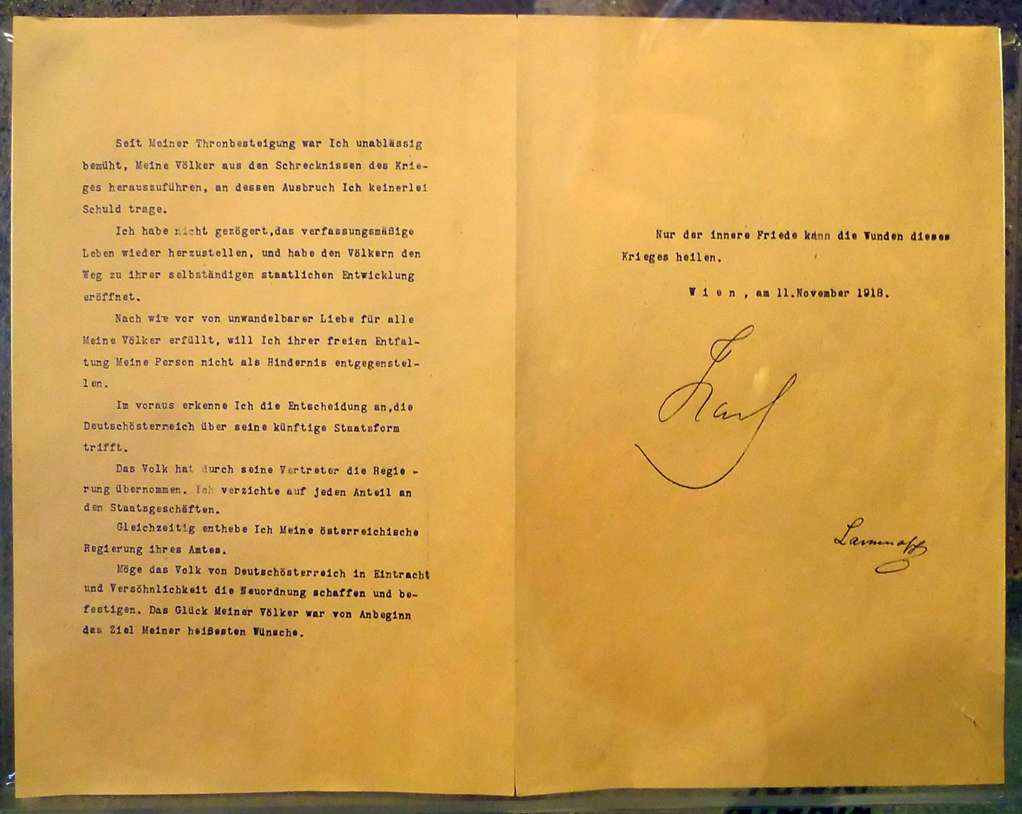
The fact that this renunciation was not entirely voluntary is made clear in a letter from the monarch to Friedrich Gustav Cardinal Pfiffl, then Archbishop of Vienna, in which he is said to have stated the following (https://www.diepresse.com/428688/abdanken-nie-nie-nie):
„I am, and shall remain, the rightful ruler of German-Austria. I have not, and shall never, abdicate …“. And further: „The present government is a revolutionary government, as it has abolished the authority of the state established by God. I would liken my manifesto of 11 November to a cheque for many thousands of crowns that a highwayman, holding a revolver to our heads, is forcing us to fill in. … Since the army could no longer be relied upon, and even the palace guard had deserted us, I resolved to sign it. I do not feel bound by this in the slightest.“
Following this letter, the monarch therefore felt compelled to declare his abdication – he was forced to take this step solely because of the „revolver held to his head“.
Nevertheless, the Provisional National Assembly proclaimed the „Republic of German Austria“ as early as 12 November 1918. This „First Republic“ initially comprised all German-speaking territories of the former Austro-Hungarian Monarchy. However, as a result of the Treaty of Saint-Germain-en-Laye, signed on 10 September 1919, the „new state“ lost a large part of its territory (e.g. South Tyrol, the Sudeten German territories, Lower Styria; cf. the remark – attributed to the French Prime Minister Georges Clemenceau –: „The rest is Austria“; cf. https://ww1.habsburger.net/de/kapitel/mythen-und-narrative-der-rest-ist-oesterreich-oder-so-aehnlich). Furthermore, a ban on joining Germany was imposed, and the state was required to change its name to the „Republic of Austria“.
Exactly one year and two months later, on 10 November 1920, the Federal Constitutional Act (B-VG) came into force; in it, the fundamental republican principle is mentioned right at the start in Article 1 – and is thus given particular prominence simply by virtue of this prominent placement.
2. ON THE REPUBLIC
A „republic“ is a form of government that is the counterpart to a monarchy. The Latin term itself res publica, Translated as „public matter“ and, in a figurative sense, referring to the state as a whole, this highlights its fundamental nature: the state is not understood as the domain of individual persons or families, but as a „matter“ belonging to the general public.
A defining feature of a republic is the legal framework governing the position of the head of state: is he elected (or does he come to power by hereditary succession)? Is he legally and politically accountable? Does he hold office for a fixed term (or for life)?
The Head of State of Austria, the Federal President, is elected directly by the people; in accordance with Article 60 of the Federal Constitutional Law (B-VG), his term of office is six years, and he may be re-elected once. As Head of State, he is politically accountable to the people, which is why he may be removed from office by the people through a referendum (Article 60(6) of the Federal Constitutional Law). From a legal perspective, he is accountable to the Federal Assembly (National Council + Federal Council): in the event of violations of the Federal Constitution, the Federal Assembly may bring charges before the Constitutional Court (Article 68 in conjunction with Article 142(2)(lita) of the Federal Constitutional Act, „state jurisdiction“).
By contrast, a monarchy is based on the rule of a single individual, whose position is usually established through dynastic or hereditary succession. Whilst monarchical heads of state are typically appointed for life and are accountable neither legally nor politically, a republic is characterised by fixed-term offices, democratic legitimacy and the legal and political accountability of its state institutions (e.g. the Federal President).
As a fundamental principle (constitutional principle) of the Federal Constitution, the republican principle enjoys a particularly high level of protection: any fundamental amendment or its complete abolition would amount to a comprehensive amendment of the Federal Constitution and, pursuant to Article 44(3) of the Federal Constitutional Law, would mandatorily require a referendum. In addition to this, the republican form of government is also safeguarded under criminal law. In particular, Section 246(1) of the Criminal Code (StGB) makes it a criminal offence (punishable by imprisonment for a term of between six months and five years) to establish associations whose purpose is to undermine the constitutional form of government of the Republic by unlawful means.
3. TO PUT IT INTO A NUTSHELL
At the head of a republic stands a body elected for a fixed term, which is accountable both legally and politically – in Austria, this is the Federal President. In a monarchy, by contrast, the head of state reigns for life, for example by right of succession, and is generally not accountable to anyone, either politically or legally.
We’d be delighted to represent you, whether on a temporary or permanent basis😉. Score big with us!
Written by:

SHMP Schwartz Huber-Medek Partner Rechtsanwälte GmbH
Hohenstaufengasse 7
A-1010 Vienna
tel: +43.1.513 50 050
fax: +43.1.513 50 05-50
office@shmp.at