
1. GENERAL
The separation of powers refers to the fundamental principle of a democratic state governed by the rule of law, whereby state power is divided into several distinct branches. The concept stems from the political theory of the French philosopher Montesquieu back to the time when, against the backdrop of an absolute ‘Sun King’, he sought a way to protect the freedom of the individual as effectively as possible. In contrast to the state in which powers are combined (the monarch as legislator, supreme judge and head of the executive), in a state organised according to the separation of powers, state authority is divided into the legislature and the executive; the executive, in turn, is subdivided into the administration (administrative branch) and the judiciary (judicial branch). These three branches of government are separated from one another both organisationally and functionally and are subject to mutual checks and balances („Checks and Balances“), to prevent the abuse of power and to safeguard citizens’ freedoms.
A distinction is made between a formal, organisational separation of powers (separation of state organs) and a substantive, functional separation of powers (allocation of specific areas of responsibility).
2. CONSTITUTIONAL BASIS
The separation of powers is particularly clearly expressed in Article 94 of the Federal Constitutional Law (B-VG), which establishes a strict separation between the judiciary – that is, the courts – and the administration, thereby ensuring a clear institutional distinction between these two branches of government. The provision reads as follows:
„The judiciary is separate from the executive in all instances.“
Furthermore, the separation of powers arises from the interplay of other constitutional principles enshrined in the Federal Constitutional Law (B-VG). Of central importance is the principle of legality under Article 18(1) of the B-VG, according to which the entire administration of the state may be exercised only on the basis of laws; according to prevailing legal doctrine, this requirement also applies to the judiciary.
In addition, there is a functional separation of powers, whereby the legislature’s role is confined to enacting general legislation, whilst the executive is responsible for its practical application and implementation.
The systematic structure of the Federal Constitutional Act (B-VG), in which the branches of government are regulated in separate sections, also illustrates this organisational separation: For example, Articles 24 et seq. in the „Second Part“ of the B-VG contain provisions on federal legislation, whilst Articles 60 et seq. in the „Third Part“ of the B-VG concern the federal executive. The term ‘executive’ is understood to encompass both the administration and the judiciary, which is presumably why Article 94 of the B-VG stipulates a clear separation between them.
3. ON THE SEPARATE BRANCHES OF GOVERNMENT
3.1. Legislation (Legislative)
Legislative power is exercised by Parliament (National Council and Federal Council; Article 24 of the Federal Constitutional Act) and by the provincial parliaments (Article 95(1), first sentence, of the Federal Constitutional Act). Their main task is to enact laws and to oversee their implementation (see point 4).
3.2. Administration (Executive)
The executive branch enforces the laws. The highest executive bodies include, in particular, the Federal President, the Federal Ministers and State Secretaries, and the members of the provincial governments. Federal executive power is exercised either through direct federal administration – that is, by federal authorities themselves – or through indirect federal administration, in which the provincial governor and the provincial authorities under his or her authority act on behalf of the federal government (Article 102(1), first sentence, of the Federal Constitutional Law). State executive power is exercised by the state governments and the state authorities subordinate to them. In addition, there is local government (mayors, local councils) and professional (e.g. AK, WKÖ, RAK) and social self-government (e.g. ÖGK).
3.3. The Judiciary
Judicial power is exercised by independent courts. Judges rule impartially and are not bound by any instructions in the performance of their duties – they are therefore independent. Their independence is safeguarded by the fact that they cannot be removed from office or transferred to another post.
4. CHECKS AND BALANCES
The separation of powers is complemented by a system of checks and balances:
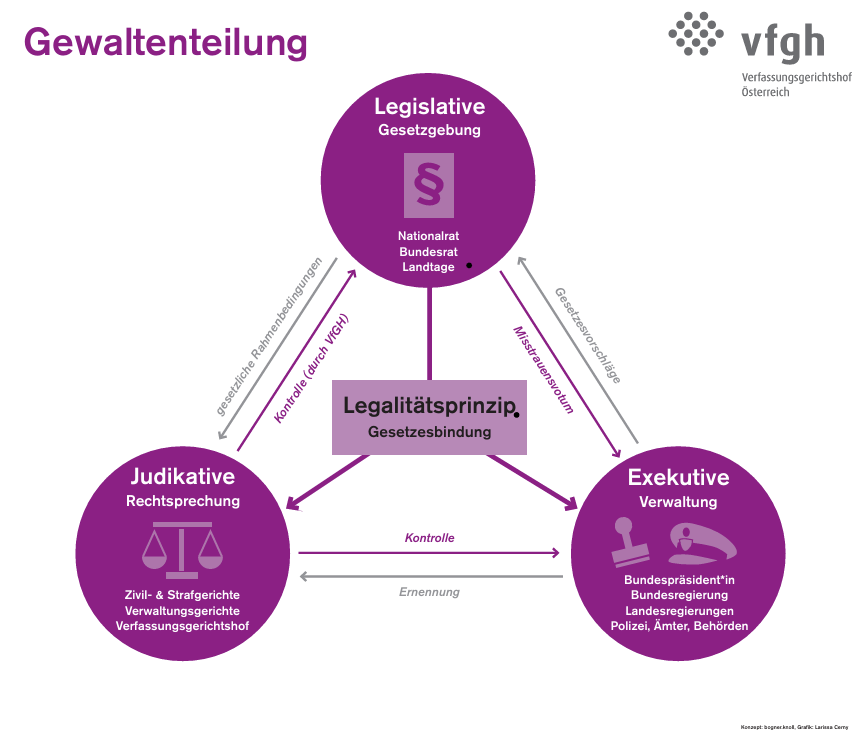
Parliament exercises a key supervisory role over the Government, for example through parliamentary questions (the right to interpellation) or a vote of no confidence. The powers of oversight over the Federal Government are set out in Article 52 of the Federal Constitutional Act (B-VG): the National Council and the Federal Council may scrutinise the conduct of government business, request information and question members of the Federal Government; individual Members of Parliament are also entitled to put short oral questions. Article 74 of the Federal Constitutional Act (B-VG) governs the vote of no confidence and grants the National Council the power to withdraw confidence from the Federal Government or individual members thereof by a majority vote, which necessarily results in their removal from office.
Furthermore, the Federal President may, on the recommendation of the Federal Government, dissolve the National Council (Article 29(1) in conjunction with Article 67(1) of the Federal Constitutional Law).
Another important supervisory body is the Constitutional Court, which reviews laws to ensure they are in accordance with the Constitution and may repeal them if necessary (Article 140(1) of the Federal Constitutional Law).
These mechanisms, listed by way of example, ensure the balance of powers within the state.
A clear diagram from the Constitutional Court illustrates the structure and interaction of the branches of government at a glance. (Available at: https://www.vfgh.gv.at/downloads/Infografik_Gewaltenteilung_NEU.pdf)
5. TO PUT IT INTO A NUTSHELL
The separation of powers is a fundamental principle of Austrian constitutional law. By dividing state power and establishing mutual checks and balances, it safeguards against the abuse of power and ensures democracy and the rule of law. In this way, it protects the freedom of the individual.
Are you affected by an administrative or judicial decision? We can help you enforce your rights and safeguard your freedoms. Let’s make a difference together!
Written by:

SHMP Schwartz Huber-Medek Partner Rechtsanwälte GmbH
Hohenstaufengasse 7
A-1010 Vienna
tel: +43.1.513 50 050
fax: +43.1.513 50 05-50
office@shmp.at