1. GENERAL
The federal government, the Länder and local authorities finance their expenditure mainly through levies. „Levy“ is the umbrella term for taxes, contributions and charges. The most important sources of revenue include, for example, income tax and payroll tax, value added tax and corporation tax, as well as various charges and contributions.
2. BUT WHERE DOES THE MONEY COME FROM TO PAY THESE CHARGES?
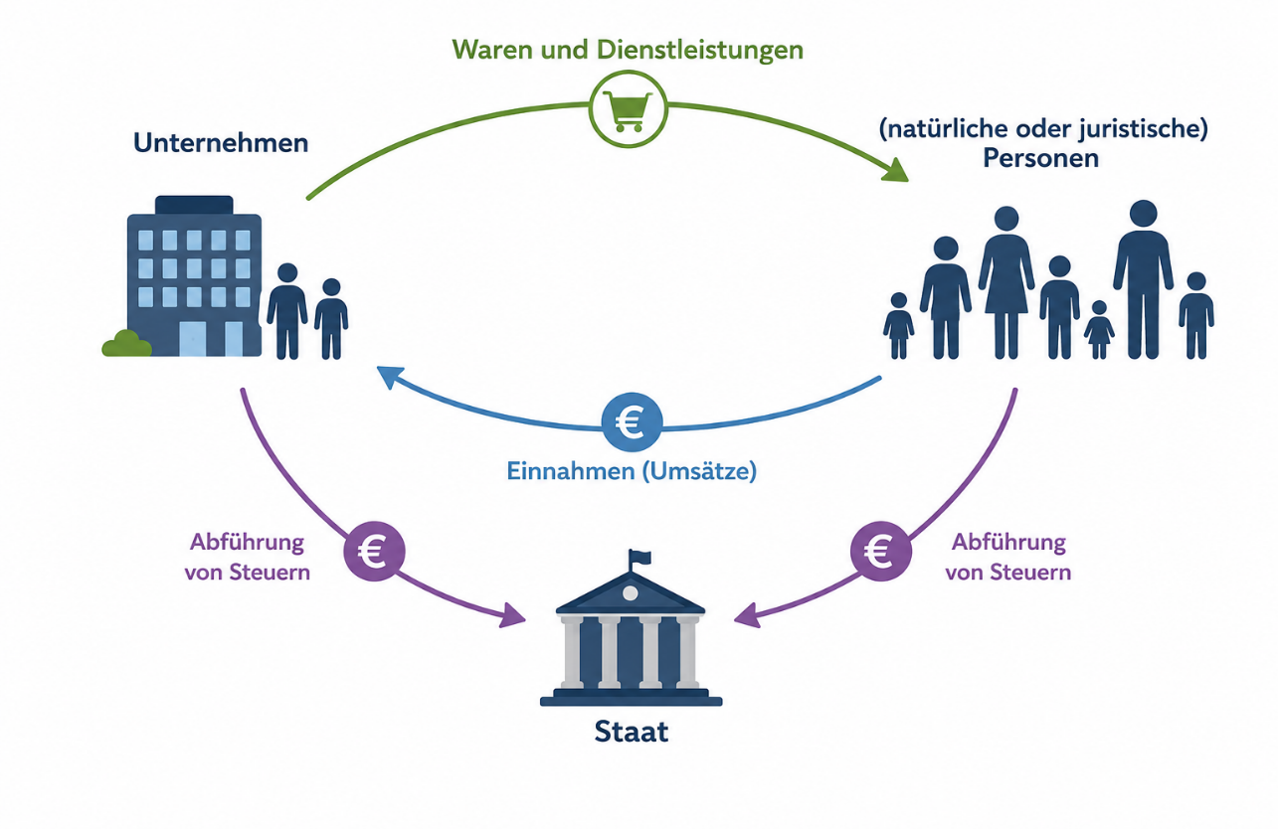
The economic basis for the state’s financing lies in the private sector. Entrepreneurs – whether they operate as sole traders, partnerships or limited companies – and the employees working in these businesses produce goods and provide services. These are offered on the market and purchased or used by other businesses or private households. This enables businesses to generate revenue („turnover“). Among other things, employees„ wages and salaries are paid from this revenue. In addition, however, companies typically also have to cover a range of other expenses. These include, in particular, rent and operating costs, the purchase of materials and goods, energy costs, insurance, social security contributions, investments and interest on loans, as well as expenditure on marketing, IT and external services (e.g. tax consultancy). After deducting all these operating expenses, a “profit’ remains. The income and profits generated are, as a rule, in turn used to purchase goods and services. This drives consumption and the economic cycle continues.
The state levies a wide variety of taxes in connection with all these activities:
a. Income tax: The income of natural persons is subject to tax. For employees, it is deducted directly from their wages in the form of payroll tax. Sole traders and partners in partnerships pay income tax on their respective income or share of profits.
b. Corporation tax: Profits made by companies are subject to tax.
c. Value added tax: The supply of goods and the provision of services are subject to tax. In economic terms, the tax is usually borne by the end consumer and paid by the business to the tax office.
Of course, there are also a wide range of other taxes, such as land transfer tax, property tax, the standard consumption tax (NoVA) – particularly on the first registration of motor vehicles in Austria – stamp duty and fees for legal transactions, as well as court and administrative fees.
Put simply, the state levies a tax on almost every economic transaction.
A thriving private sector is therefore the most essential foundation for the financing of government functions. Although the state may itself engage in private-sector activities and, for example, generate revenue from public enterprises or shareholdings, this is not its main source of income. Traditional functions, such as administration, education, policing and infrastructure, are predominantly financed through taxes.
3. INHERITANCE TAX
The much-discussed inheritance tax – like a gift tax – does not currently exist in Austria. In my view, the following should be taken into account in the debate over its introduction: In the event of inheritance, a court fee amounting to 0.5‰ of the net estate is payable; this fee is not capped. It should also be borne in mind that the inherited assets have in many cases already been subject to tax. This can be illustrated particularly clearly using the example of a property: the purchase price paid for the property usually stems from income that has already been taxed. The purchase itself gives rise to further significant costs – in particular, land transfer tax and the land registry registration fee, as well as other fees and ancillary costs, which amount to a total of around 10% of the purchase price. But the financial burden does not end there: property tax (an annual levy) must also be paid on an ongoing basis whilst the property is owned. The same asset has therefore already been subject to taxes and levies on multiple occasions during the course of its acquisition and ownership.
4. HOW ARE THE CHARGES ALLOCATED?
Austria comprises three levels of government: the federal government, the provinces and the municipalities. Each of these levels has its own responsibilities and its own budget.
Many of the most important taxes are levied by the federal government. However, this does not mean that all of the revenue remains with the federal government. The revenue is divided between the federal government, the Länder and the local authorities in accordance with specific legal rules. In addition, the Länder and local authorities may also levy their „own“ taxes (e.g. entertainment tax).
The legal basis for this is, in particular, the Constitutional Finance Act
(F-VG). It lays down the basic rules governing financial relations between the federal government, the Länder and the local authorities. The specific allocation of tax revenue is then regulated by the Financial Equalisation Act (FAG). In particular, this Act specifies how joint federal taxes (e.g. income tax, corporation tax, value added tax) are divided between the federal government, the Länder and the local authorities. The current FAG 2024 is valid until the end of 2028.
The basic system can therefore be described – in very simplified terms – as follows:
 5. TO PUT IT IN A NUTSHELL
The economic basis for public finance lies in the private sector. The state levies taxes on this basis. The revenue generated is distributed between the federal government, the Länder and the local authorities in accordance with statutory rules, and is used to fund their respective public services.
We are also happy to represent you before the Federal Finance Court or the Administrative Court in tax matters. So, as always, the same applies here: score points with us!
Written by:

SHMP Schwartz Huber-Medek Partner Rechtsanwälte GmbH
Hohenstaufengasse 7
A-1010 Vienna
tel: +43.1.513 50 050
fax: +43.1.513 50 05-50
office@shmp.at