1. GENERAL
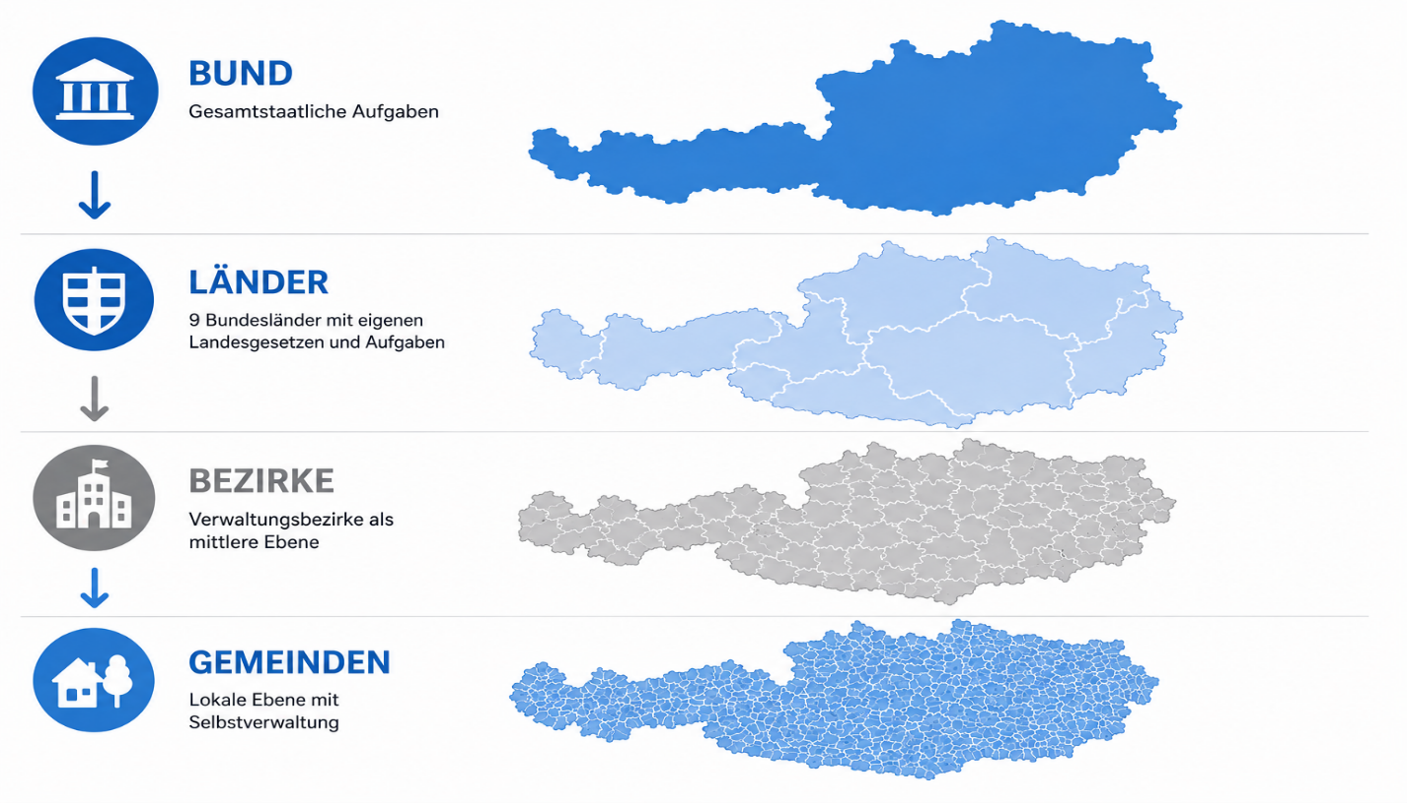
The next ‘Knowledge Bite’ focuses on the statutory cities. To help us better understand their place within the Austrian state and administrative structure, this time we’ll start by taking a broad look at the structure of Austria as a whole – that is, the interplay between the federal government, the provinces, the municipalities – and the districts!
In simple terms, Austria can be thought of as a map with several layers: the federal government covers the entire territory of Austria. However, according to Article 2 of the Federal Constitutional Law (B-VG), Austria is not a centralised state, but a federally organised federal state comprising nine federal states. The federal government and the federal states share state responsibilities (legislation and enforcement); Articles 10 to 15 of the Federal Constitutional Law (B-VG) („Distribution of Powers“) set out which level is responsible for what.
The federal states are divided into municipalities. Under Article 116(1) of the Federal Constitutional Law (B-VG), a municipality is a separate local authority with the right to self-government. In particular, it manages independently those matters which are in the exclusive or predominant interest of the local community and are suitable for being dealt with within its local boundaries. This so-called „own sphere of activity“ is set out in more detail in Article 118 of the Federal Constitutional Law (B-VG). In addition, however, municipalities must also undertake administrative tasks on behalf of the federal state in which they are situated and the Federal Government (the so-called „delegated sphere of activity“).
From an administrative and organisational perspective, districts are situated between the federal states and local authorities. However, they do not constitute a separate local authority in their own right, but merely serve as administrative districts. Several municipalities are grouped together to form a district so that state administrative tasks can be carried out in a coordinated and efficient manner at regional level (i.e. above the level of individual municipalities, but below the provincial level). The authorities responsible for this are generally the „district administrations“, which, pursuant to Section 8(5)(b) of the 1920 Constitutional Act (ÜG 1920), are required to „manage both the affairs of the indirect federal administration and those of the provincial administration“.
The federal state of Vienna occupies a special position, which will be discussed in more detail in a separate „Trivia“ piece (“Vienna is different!” 😉).
2. EXAMPLE
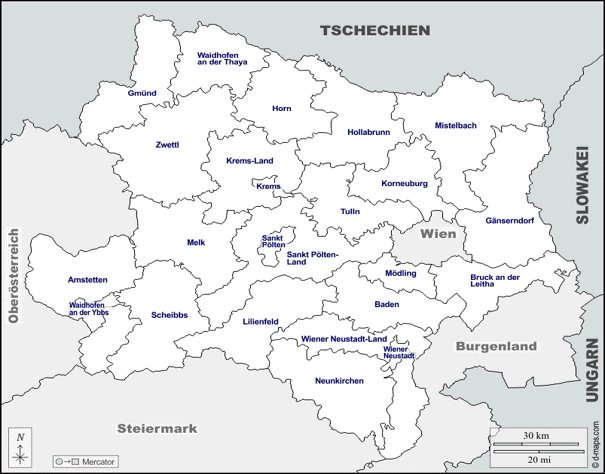
The example of Mödling illustrates this administrative structure well: the federal state of Lower Austria comprises, amongst other things, the administrative district of Mödling – south of Vienna (https://www.d-maps.com/carte.php?lang=de&num_car=33866&utm).
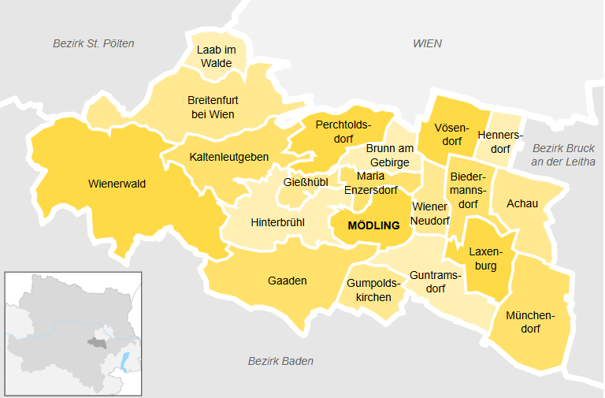
The administrative district of Mödling comprises 20 municipalities (including Mödling, Perchtoldsdorf, Brunn am Gebirge, Maria Enzersdorf, Guntramsdorf, Vösendorf and Wiener Neudorf; https://upload.wikimedia.org/wikipedia/commons/3/31/Municipalities_Bezirk_Mödling.svg?utm_source=de.wikipedia.org&utm_campaign=index&utm_content=original).

The district of Mödling thus forms – figuratively speaking – an „administrative bracket“ around several municipalities. This division is also used for elections: under Section 2 of the Lower Austrian Provincial Election Regulations 1992, Lower Austria is divided into 20 constituencies; the administrative district of „Mödling“ constitutes constituency No. 13.
Furthermore, there are four statutory cities in Lower Austria – these do not constitute additional constituencies, but are assigned to existing ones (e.g. Waidhofen an der Ybbs is part of the Amstetten constituency). But more on that in the next ‘Wissens-Schnitzerl’.
3. TO PUT IT INTO A NUTSHELL
The federal government, the Länder and the municipalities are territorial authorities; districts, on the other hand, are administrative areas in which several municipalities are grouped together for organisational reasons. This is intended, in particular, to simplify administration (indirect federal administration and Land administration) within the territories of the municipalities concerned.
Naturally, we not only assist individuals and legal entities with legal matters, but also offer our legal expertise to local authorities and district administrations in the form of advice and support. You too can benefit from working with us!
Written by:

SHMP Schwartz Huber-Medek Partner Rechtsanwälte GmbH
Hohenstaufengasse 7
A-1010 Vienna
tel: +43.1.513 50 050
fax: +43.1.513 50 05-50
office@shmp.at