
1. INTRODUCTION
As explained in the previous „Knowledge Bite“, the hierarchical structure of the legal system based on derogatory power (as opposed to that based on legal conditionality) should, in principle, be given preference. This is primarily because it not only makes it easier to organise a state’s legal system systematically, but also to represent it graphically (in practice, therefore, this is what is meant when reference is made to the ‘hierarchical structure of the legal system’). It is precisely this advantage that we intend to make use of in the following.
2. GENERAL INFORMATION
The hierarchical structure of the legal system, based on the principle of derogation, organises and systematises a state’s legal system. Put simply, it shows which legal norms are of higher rank and which are of lower rank. This model originates from the Austrian legal scholar Adolf Julius Merkl back. What makes this special is that it allows the complex legal system of a state to be represented graphically in a simple and clear manner. This is comparable to the periodic table in chemistry, where one can see at a glance which elements, for example, are solid, liquid or gaseous. The same applies to the hierarchical structure of the legal system: at a glance, one can see the relationship between, for example, the constitution, laws and regulations.
What, then, can be inferred from the hierarchical structure of the legal system? Essentially, it reflects two fundamental principles: the principle of legal basis and the principle of consistency. The principle of hierarchical relationship means that a lower-ranking legal norm must be based on a higher-ranking norm which authorises its enactment. For example, a regulation generally requires a statutory basis. The principle of consistency stipulates that a lower-ranking legal norm must not contradict a higher-ranking one. A regulation, for instance, must therefore not contravene an Act, and an Act must not contravene the Constitution. The hierarchical structure thus not only shows which legal norms take precedence, but also the legal basis on which they rest and the limits imposed upon them.
3. GRAPHIC
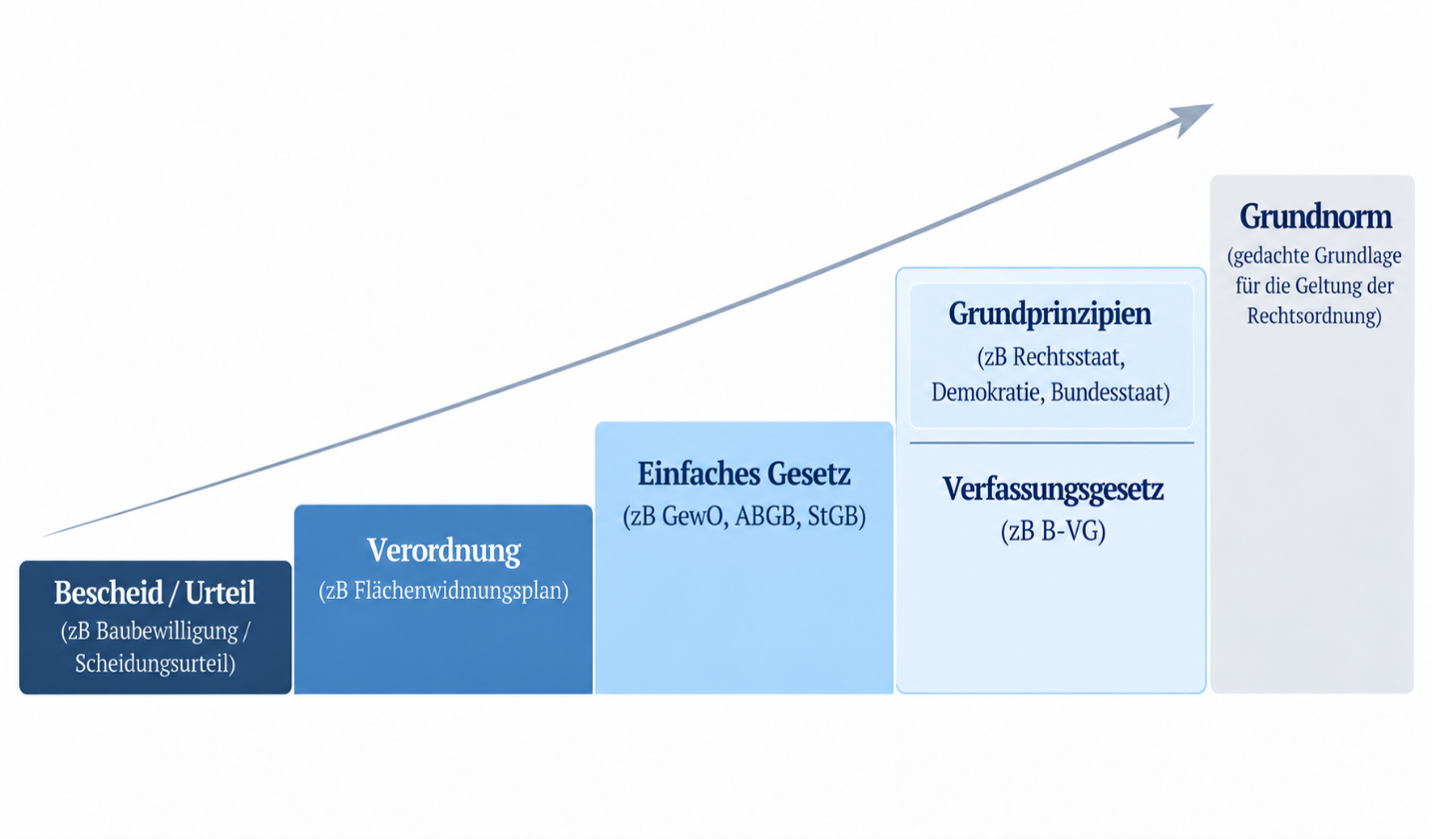
4. THE VARIOUS LEVELS OF THE LEGAL SYSTEM
4.1. Constitutional Act
Federal constitutional law constitutes the highest level of domestic law. This includes, in particular, the Federal Constitutional Act (B-VG) and other constitutional laws (e.g. the Basic Law on the General Rights of Citizens). Constitutional laws require a two-thirds majority in the National Council.
The fundamental principles of the Federal Constitution (e.g. democracy and the rule of law) form part of constitutional law, but occupy a special position within it. If a fundamental principle of the Federal Constitution is substantially altered or repealed in its essential content, or if a new fundamental principle is introduced, this constitutes a comprehensive amendment to the Federal Constitution. In such cases, the qualified decision-making requirements for constitutional law apply. In addition, a referendum is mandatory.
4.2. Simple law
Ordinary laws rank below constitutional law. Examples include the General Civil Code (ABGB), the Criminal Code (StGB) and the Road Traffic Regulations (StVO).
4.3. Regulations
Regulations are issued by administrative authorities and serve to implement statutory provisions in greater detail. They must have a statutory basis and must not contradict the law. The basis for this is the principle of legality set out in Article 18 of the Federal Constitutional Act (B-VG): Under Article 18(1) of the Federal Constitutional Act (B-VG), the entire state administration may be exercised only on the basis of laws; under Article 18(2) of the Federal Constitutional Act (B-VG), administrative authorities may issue regulations within their sphere of competence only on the basis of laws.
4.4. Decisions / Judgements
Decisions, judgements and orders are legal acts issued to resolve specific individual cases. Decisions are individual administrative acts, whilst courts, depending on the subject matter of the proceedings, rule by means of a judgement or an order. These decisions must be based on a valid legal basis. Examples include planning permission, tax assessment notices and court judgements.
5. BUT WHAT IS CONSTITUTIONAL LAW BASED ON?
If every legal norm is based on a higher-ranking norm, the question inevitably arises: on what is constitutional law itself based?
To answer this question, the legal scholar developed Hans Kelsen the concept of the so-called fundamental norm. It constitutes the highest conceptual basis for the validity of a legal system. However, this is not an actual law, but rather a purely theoretical construct. The fundamental norm is taken as a given in order to explain why the constitution – and thus all other legal norms – are valid.
The fundamental norm is entirely value-neutral in this respect. It makes no judgement as to whether a legal system is good or bad, just or unjust. Rather, its intended content may vary depending on the legal system: for example, the fundamental norm of a theocratic state, whose legal system is fundamentally shaped by religious precepts, may differ from that of a secular state, in which the state and religion are fundamentally separate.
6. WHERE DO TREATIES UNDER INTERNATIONAL LAW FIT INTO THE CLASSIFICATION SYSTEM?
Under Austrian law, international treaties may occupy different levels within the legal hierarchy. For example, the European Convention on Human Rights (ECHR) has constitutional status, whilst other international treaties may have the same status as ordinary laws.
7. REVIEW BY THE CONSTITUTIONAL COURT
Compliance with the hierarchy of norms is ensured in particular by the Constitutional Court (VfGH). It has the power to annul unconstitutional laws and unlawful regulations, and to rule on conflicts of jurisdiction between the federal government and the Länder. In this way, the VfGH plays a key role in ensuring that the legal system remains uniform, free from contradictions and in accordance with the Constitution.
8. THE RELATIONSHIP BETWEEN UNION LAW AND NATIONAL LAW
Within its scope of application, EU law generally takes precedence over national law. Where Austrian law conflicts with directly applicable EU law, the national law must not be applied in the specific case.
9. TO PUT IT IN A NUTSHELL
The hierarchical structure of the legal system describes the hierarchical order of sources of law: lower-ranking legal provisions must be based on higher-ranking ones and must not contradict them. This makes it clear which legal provisions take precedence and on what basis they are founded.
Whatever legal provision you’re dealing with, we’re here to advise you. Score points with us!
Written by:

SHMP Schwartz Huber-Medek Partner Rechtsanwälte GmbH
Hohenstaufengasse 7
A-1010 Vienna
tel: +43.1.513 50 050
fax: +43.1.513 50 05-50
office@shmp.at