
1. GENERAL
„Validity“ refers to the specific existence of a legal norm. A legal norm that is valid has come into being in law.
The term „entry into force“ refers to the point from which a legal provision becomes binding – in other words, the point from which it must be complied with should (see the 2nd and 4th ‘Trivia Bits’).
Whilst „validity“ and „entry into force“ are normative terms – that is, terms governed by positive law (see Knowledge Trivia No. 2) – the concept of „effectiveness“ is a purely statistical one. It merely describes whether a legal norm that is in force and has entered into force in fact is complied with (or whether, in the event of non-compliance with this legal provision, the prescribed sanction in fact is imposed).
2. SCOPE
Article 49(1) of the Federal Constitutional Act (B-VG) stipulates that federal laws must be published by the Federal Chancellor in the Federal Law Gazette. „Unless expressly provided otherwise, they shall enter into force at the end of the day on which they are published and apply “across the whole of Germany’ (emphasis added). Similar regulations also exist at state level (federal states).
The legal norm known as the „Federal Act“ thus comes into being in their announcement in the Federal Law Gazette.
For every legal provision, a distinction can be made between its temporal, territorial, material and personal scope (see ‘Knowledge Trivia’ No. 6): The temporal scope describes the period during which a provision is in force (When?), the territorial scope refers to the territory to which a legal provision applies (Where?), the material scope refers to the types of conduct or situations that the provision is intended to cover (What?), and the personal scope identifies the group of people to whom the legal provision applies (Who?).
3. BINDING EFFECT (ENTRY INTO FORCE/CEASING TO HAVE EFFECT)
3.1 Entry into force
It is only upon its entry into force that a law establishes rights and obligations for those to whom it applies; it is only upon its entry into force that a legal provision becomes legally binding.
Article 49(1) of the Federal Constitutional Act (B-VG) stipulates that federal laws „[u]nless expressly provided otherwise, … shall enter into force at the end of the day on which they are promulgated’ “in force" come into force (emphasis added). However, other provisions may be laid down: the Act itself may stipulate that it is to come into force at a later date (legislative gap) or at an earlier date (retroactive effect).
Example 1: Act A was published on 1 November 2025. The Act stipulates that it will not come into force until 1 January 2026. There are therefore two months between its publication and its entry into force. This period is known as the legislative gap.
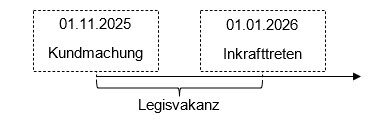
However, the legislature may also stipulate that a legal provision is to be previous date – that is, with retroactive effect – comes into force.
Example 2: Act B was published on 1 November 2025. It comes into force on 1 September 2025. This Act therefore has retroactive effect for two months.
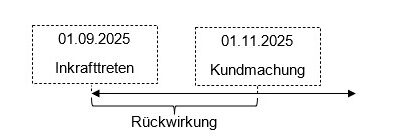
This is remarkable insofar as, on 15 September 2025, for example (see Example 2), a legal situation will apply which did not even exist at that time. This strikes at the very foundations of the rule of law: how is one supposed to comply with a legal norm that one does not even know about yet? could? With the exception of criminal laws (Article 7(1) of the ECHR: „No punishment without law“), such retroactive legal provisions may nevertheless be constitutionally permissible, provided they are objectively justified in the light of the principle of equality (Article 2 of the StGG, Article 7 of the B-VG).
Important: The dates of application and entry into force are usually different: the application of, for example, a federal law begins upon its publication in the Federal Law Gazette, but it does not enter into force until the following day. The two dates therefore coincide only if the law itself provides for retroactive effect (e.g. „This law shall enter into force on the day of its publication“).
3.2 Termination
a. Temporary legal provision
When a legal provision ceases to be in force, it loses its legal binding force – it no longer establishes any rights or obligations for those subject to the law.
When enacting a legal provision, the legislature may stipulate that it shall only up to a certain point in time is to be binding. The Act will therefore cease to have effect at that point. It is a temporary legal provision.
Example 3: Act C stipulates that applications for certain subsidies (e.g. for the purchase of electric cars) may only be made for the period between 1 December 2026 and 1 December 2027.
b. Derogation
Usually, however, a legal provision is not enacted for a fixed period; rather, it is generally superseded by a conflicting „new“ legal provision (usually of the same rank)*. The legislature has the following options in this regard: Firstly, it may expressly stipulate that an old legal provision ceases to have effect – this is formal derogation called.
*This refers to the hierarchical structure of the legal system. This will also be covered in a ‘Knowledge Bite’.
Example 4: On 24 December 2025, Section 15 of the „Federal Act on the Regulation of …“ will cease to have effect.
In the case of a substantive derogation If, on the other hand, the legislature fails to include such an explicit provision for repeal, the conflict between the old and new legal provisions arises in this case rather from the fact that the new provision governs the same subject matter as the old legal provision – albeit with different content. This results in the old legal provision being superseded („lex posterior derogat legi priori“ = the later legal provision supersedes the earlier one).
Example 5: Section 33(1)(1) of the Fees Act 1957 (BGBl 267/1957, as amended by BGBl I 113/2024) provided as follows (previous legal position): „Gambling contracts, whereby the hope of a yet uncertain benefit is promised and accepted: Bets concluded within Germany that are not subject to the GSpG, provided that at least one of the parties to the legal transaction is an entrepreneur within the meaning of Section 2(2) of the GSpG, amounting to … 2 per cent of the stake“.
Until 1 April 2025, a betting fee of 2% was therefore payable. Under Federal Law Gazette I 7/2025, the fee was increased from 2% to 5%. The later legal provision repealed the earlier one.
4. TO PUT IT INTO A NUTSHELL
A careful distinction must be made between validity, entry into force and effect. A legal provision is legally binding only from the time it enters into force until the time it ceases to have effect.
As a general rule, federal laws, for example, come into force on the day following their promulgation. However, the legislature may also decide that they should come into force at a later date (legislative gap) or at an earlier date (retroactive effect).
A legal provision ceases to have effect if it is subject to a time limit or if it is expressly repealed by the legislature (formal derogation). However, a legal provision may also cease to have effect if it is replaced by a provision that differs in substance (substantive derogation).
The temporal scope plays a crucial role in practice and is a key factor in determining whether a case is won. We’d be delighted to help you win! Score a win with us!
Written by:

SHMP Schwartz Huber-Medek Partner Rechtsanwälte GmbH
Hohenstaufengasse 7
A-1010 Vienna
tel: +43.1.513 50 050
fax: +43.1.513 50 05-50
office@shmp.at